
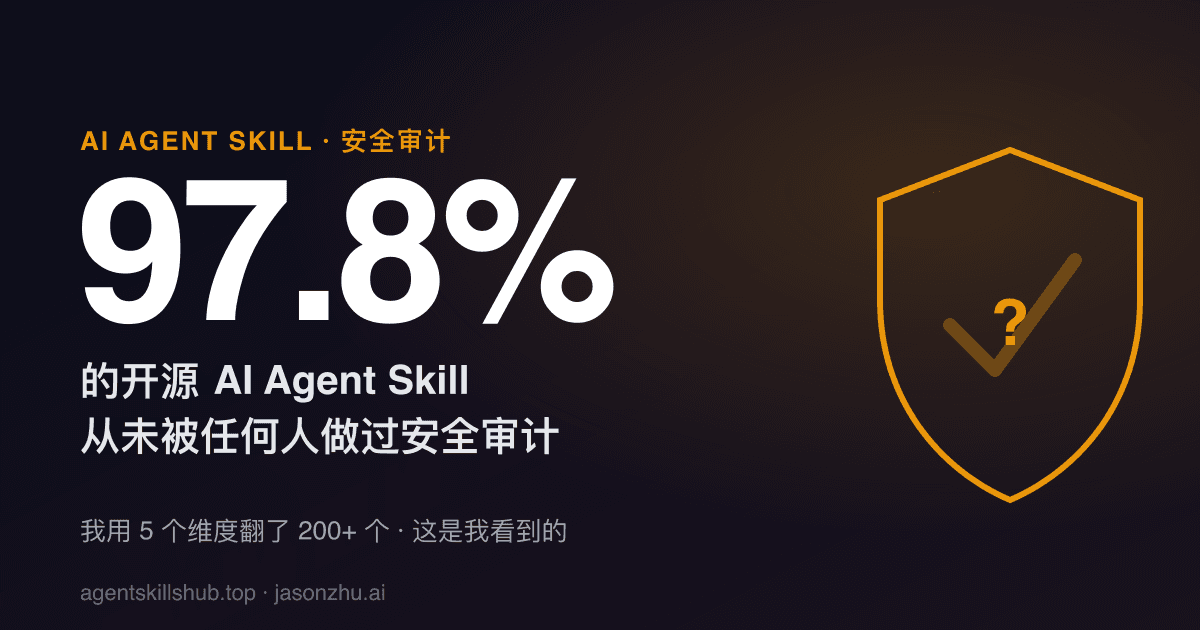
I Audited 200+ Open-Source AI Agent Skills — 97.8% Have Never Had a Security Review
Your AI agent installed a few open-source skills last week.
Who reviewed them?
I did something most people skip: I treated open-source AI agent skills as supply chain dependencies and audited them seriously. Not checking star counts or whether the README looks polished — actually digging into whether they ask for your credentials, whether there's anything hidden in the code, who the maintainer is, and whether there's any accountability if something goes wrong.
I went through 200+, doing deep scans on a meaningful subset. Here's what I found — and why I think this is one of the most underrated risks heading into 2026.
The Most Counterintuitive Finding First
Our directory currently indexes 105,000+ open-source agent skills, MCP servers, and Codex skills. When I pulled their security rating distribution, this is what it looked like:
| Security Rating | Share |
|---|---|
| unknown (never reviewed) | 97.8% |
| safe (reviewed, no issues) | 2.1% |
| caution / unsafe / reject (flagged) | 0.1% |
Let that sink in.
The real risk isn't "lots of skills are malicious" — it's "the vast majority of skills are black boxes." Out of 100,000 skills, 98,000 of them have never had a single security check by anyone, including the people using them. You install them, hand over your API keys, let them run commands in your environment — all based on how nice the README looks.
Among the 2,300+ we've actually rated, 94% are clean and about 5.6% triggered warnings or rejections. That ratio sounds manageable — but remember, those 2,300 are just the tip of the iceberg. Nobody knows what's in the other 100,000.
The 5 Dimensions I Use
When I audit a skill as a supply chain dependency, I always look at five layers:
- Code layer — Obfuscated code? Suspicious network requests? Does it download and execute external files at runtime?
- Credential handling — What does it ask for? Where are keys stored — locally, or uploaded to a remote server somewhere?
- Vendor trustworthiness — Who's the maintainer? Real name, organization, or an anonymous account with 0 followers? Is there a flight risk?
- Supply chain — What does it depend on? Any typosquatting, deleted upstream packages, or artificially inflated star counts?
- Operational risk — If the service goes down, gets hacked, or jacks up prices, what's your exposure? Are there audit logs for accountability?
Of these five, the code layer is the easiest to check and the operational layer is the most dangerous to overlook. The three real-world cases below illustrate exactly that.
Case A: The "Completely Normal" One Is the Most Dangerous
I audited an open-source social media scheduling skill. On the surface it was impeccable:
- ✓ Thousands of stars
- ✓ Complete documentation
- ✓ Demo video
- ✓ MIT license
The code itself had no obvious malicious behavior — zero runtime dependencies, clean. By the "check stars and docs" standard, it would score full marks.
But I hit the brakes on credential handling and operational risk: every social media account you connect through this skill has its OAuth tokens stored not locally, but on the maintainer's remote server. And that maintainer is an anonymous account — no real name, no company entity, no DPA, no compliance commitments of any kind.
What does that mean? If that server is ever compromised, an attacker gains posting access to every platform account you've connected. A company's brand account could turn into a crypto ad farm overnight. This isn't fear-mongering — it's the inevitable attack surface of combining "remote credential hosting" with "anonymous operation."
Bottom line: works fine ≠ production-ready. Fine for a personal throwaway account. Never connect a brand or business account.
Case B: Stars Lie. Audits Don't.
The flip side also surprised me.
I came across a skill with 0 stars and almost scrolled past it. Then I opened its SKILL.md and found 8KB of engineering-grade methodology, with priorities explicitly hardcoded up front:
No hallucination > No misreading of source material > Mechanism clarity > Readability > Relevance of examples > Virality of phrasing
Only someone who's actually built this and hit the pitfalls writes rules like that. The quality blew most 50,000-star "influencer skills" stitched together from prompt templates completely out of the water.
Why 0 stars? Unfriendly repo name, Chinese-only README, 0-follower author, zero promotion. Discoverability failure, not quality failure.
This confirmed something I now believe firmly: star count is the worst metric for judging a skill. It measures marketing, not engineering.
Case C: What Enterprise-Grade Actually Looks Like
So what does "good" look like? I audited an ECS troubleshooting skill suite released officially by Alibaba Cloud — it's a useful benchmark:
- 51 security analyzers + 10 data collectors
- Coverage across processes, networking, authentication, persistence, rootkits, malware, memory forensics, and container escapes
- Maps to 103+ MITRE ATT&CK techniques
- 88 kernel CVE detectors with a built-in CTF framework to automatically verify vulnerability reproducibility
Official organization, Apache 2.0, actively maintained. This is something with real security engineering investment behind it — worlds apart from the "prompt wrapper + call Nmap" toys that also get called "skills."
Two things can both be called a "skill" and be separated by entire orders of magnitude in rigor. And average users have no tools to tell the difference.
What I'm Doing About It
This is exactly why we built Agent Skills Hub.
It's not "yet another open-source directory." Directories solve "what exists" — they don't solve "what can be trusted." We're building the trust layer for agent skills: every skill goes through three dimensions —
- 🟢 Security: Static scanning + credential, supply chain, and operational risk assessment
- 🟢 Quality: 6-dimension quality scoring, no star dependence
- 🟢 Maintenance activity: Still being iterated on, or effectively abandoned
Red flags get flagged. Verified skills get certified. The goal is to slowly turn that 97.8% black box into something checkable, trustworthy, and production-ready.
Three Invitations
1. Got a skill you're not sure about? Drop a GitHub link in the comments and I'll run it through all 5 dimensions. First 10 are free, sorted by popularity.
2. Are you an official skill maintainer who wants Verified status? We're building a Verified Creator / Verified Organization program — official skills that pass the audit get a ✓ badge and featured placement. DM me.
3. Want to check for yourself? Head to agentskillshub.top, search for any skill you're using, and see its scores and flags.
Back to the question I opened with: who actually reviewed those skills your agent installed last week?
If the answer is "nobody" — now you know where to look.
Subscribe to Newsletter, get the full playbook free
Subscribe to receive the complete "AIP Overseas Social Media Playbook" plus weekly AI curated content
Related Posts
Jason Zhu
Ex-AI Engineer | AI Blogger