AI News · 2026-05-02

· JasonZhu.AI · Compiled by AI

AI News · 2026-05-02

AI summary · this digest is compiled by AI, not yet reviewed by Jason

The story to watch today is the methodology race in the Skills ecosystem: mattpocock's small, composable Skills versus Superpowers' complete methodology. Whichever approach wins out will shape the dominant paradigm for Agent development.

🔥
SkillsGitHub Trending

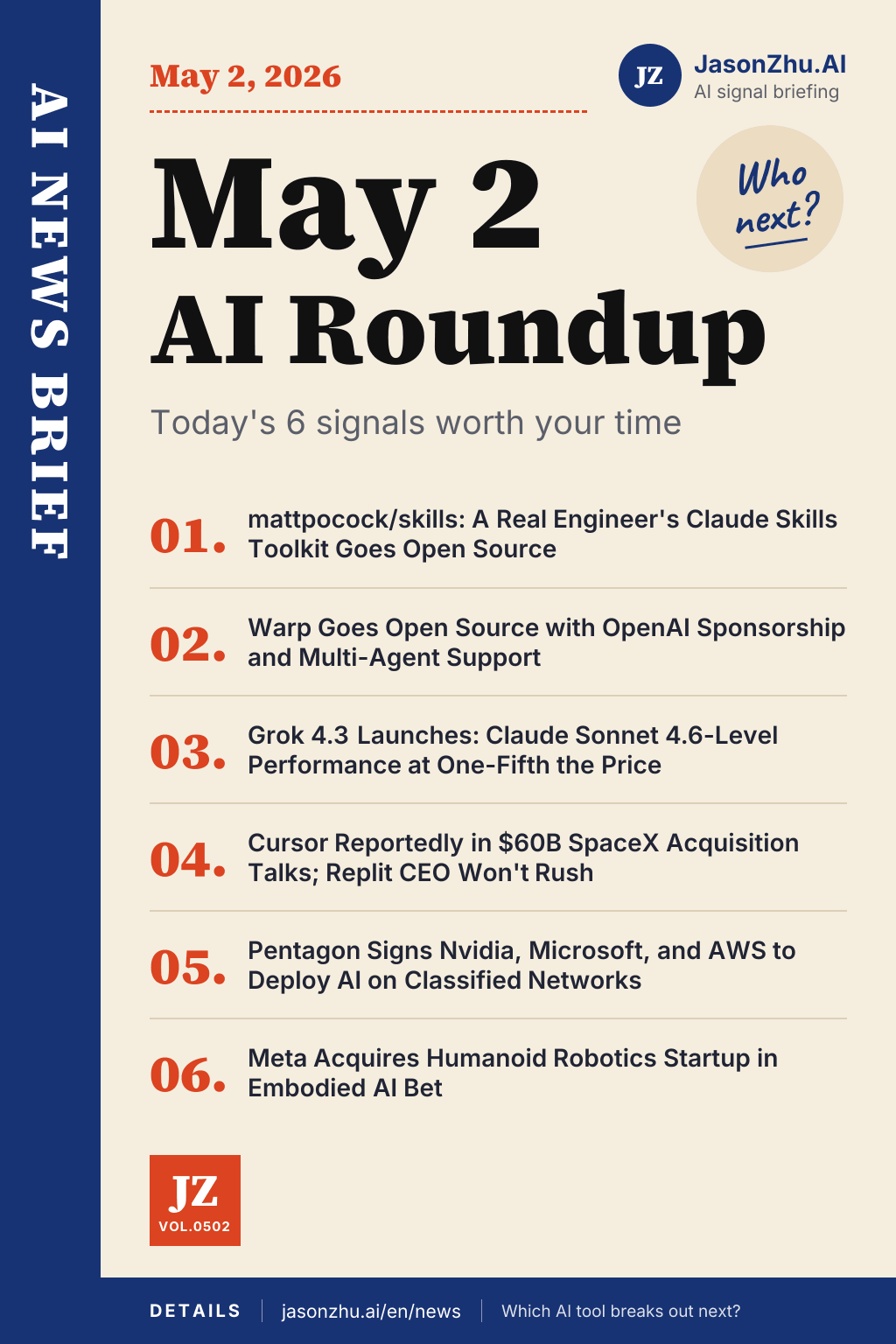
Warp Goes Open Source with OpenAI Sponsorship and Multi-Agent Support↗

The Warp terminal is now open source, with OpenAI as lead sponsor. It includes a built-in agentic development environment and works with CLI agents such as Claude Code, Codex, and Gemini CLI. The move signals that terminal tools are entering a multi-agent orchestration era, accelerating the consolidation of developer workflows.

🛠️
AI ToolsTechCrunch AI

Pentagon Signs Nvidia, Microsoft, and AWS to Deploy AI on Classified Networks↗

The US Department of Defense has announced agreements with Nvidia, Microsoft, and AWS to deploy AI on classified networks. The move follows a dispute with Anthropic over AI usage terms and aims to reduce reliance on any single vendor. It marks a shift toward concrete, real-world military AI deployment.

🛠️
AI ToolsTechCrunch AI

Meta Acquires Humanoid Robotics Startup in Embodied AI Bet↗

Meta has acquired humanoid robotics startup Assured Robot Intelligence to strengthen its robotics AI models. The deal formally puts Meta in competition with Tesla, Google, and others as the arms race among tech giants in embodied intelligence continues to heat up across the industry.

📚
AI PapersHuggingFace Papers

Does Fine-Tuning Erode Safety Alignment? Tests on 100 Models Suggest Yes↗

Researchers tested 100 fine-tuned models, including medical and legal ones, and found that a base model passing safety evaluations doesn't guarantee its fine-tuned versions remain safe. Domain adaptation can cause significant safety alignment drift, a critical blind spot for any developer deploying fine-tuned models in production.

📚
AI PapersHuggingFace Papers

Step-Level Compute Allocation Cuts Computer-Use Agent Costs Without Losing Accuracy↗

Current computer-use agents like Claude Computer Use call a large model at every step, making them slow and expensive. This paper proposes step-level compute allocation: small models handle simple actions, and large models are reserved for complex decisions. The approach sharply reduces inference costs while maintaining performance, offering practical guidance for developers building GUI automation products.

Subscribe for daily AI updates + free playbook

📘 Subscribe Free