AI News · 2026-05-16

· JasonZhu.AI · Compiled by AI

AI News · 2026-05-16

AI summary · this digest is compiled by AI, not yet reviewed by Jason

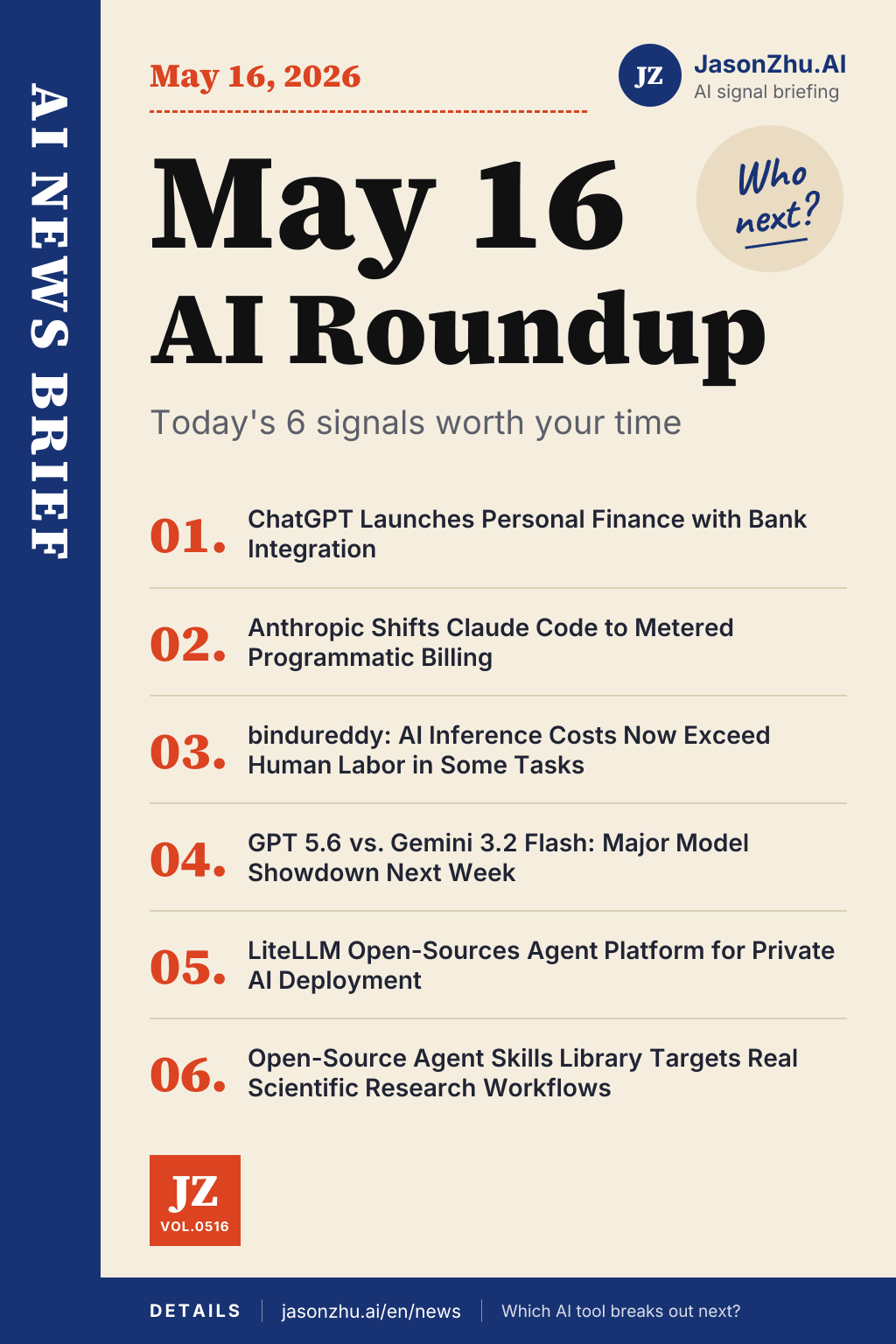
3 things to watch today: Anthropic reprices Claude Code (metered billing for programmatic usage), OpenAI connects bank accounts for personal finance, and bindureddy's quip that 'AI now costs more than hiring humans' — AI productization is entering a pricing-model reset phase, and per-seat billing is making an unexpected comeback.

🛠️
AI ToolsTechCrunch AI

ChatGPT Launches Personal Finance with Bank Integration↗

OpenAI has released ChatGPT for personal finance, letting users authorize direct bank account connections for budget analysis, transaction categorization, and spending advice. This marks ChatGPT's first move into consumer finance, posing a direct threat to personal finance SaaS players like Mint, Copilot Money, and Cleo as AI assistants compete for the highest-trust household money management use case.

🛠️
AI ToolsLatent Space

Anthropic Shifts Claude Code to Metered Programmatic Billing↗

Anthropic is breaking out programmatic and automation-based Claude Code usage into separate metered billing, moving away from per-seat pricing. For independent developers and small teams running heavy automated workflows, total cost of ownership could rise sharply, forcing a reassessment of agent pipeline economics.

🛠️
AI ToolsX/@bindureddy

bindureddy: AI Inference Costs Now Exceed Human Labor in Some Tasks↗

bindureddy surfaced a counterintuitive observation: in many heavy-inference scenarios, the per-task cost of AI already exceeds the marginal cost of hiring a human for the same work, joking 'Humans are sooo back!' The deeper issue is that the first wave of 'AI is cheaper than people' gains has ended in certain domains, and the next round must prove quality justifies equal or higher cost.

🛠️
AI ToolsX/@bindureddy

GPT 5.6 vs. Gemini 3.2 Flash: Major Model Showdown Next Week↗

bindureddy flagged a key inflection point: GPT 5.6 and Gemini 3.2 Flash are set to launch in the same window next week. Gemini 3.2 Flash reportedly leverages DeepMind distillation techniques to push stronger performance at the Flash price tier. This is a direct head-to-head between OpenAI and Google for the 'affordable yet capable' developer segment.

🔥
SkillsHacker News

LiteLLM Open-Sources Agent Platform for Private AI Deployment↗

LiteLLM has launched an open-source Agent Platform enabling enterprises to run Claude Code, Codex, Cursor, and similar coding agents on their own infrastructure, with built-in sandbox isolation and secret vault management. For compliance-sensitive sectors like finance, healthcare, and government, it provides critical middleware for deploying AI coding agents entirely within private networks.

🔥
SkillsGitHub Trending

Open-Source Agent Skills Library Targets Real Scientific Research Workflows↗

K-Dense-AI has open-sourced scientific-agent-skills, an agent skills library built for research workflows including paper retrieval, experimental design, data analysis, and literature review. The project marks a significant expansion of the agent skills ecosystem from productivity tools into professional knowledge work, offering direct reference value for teams building academic, pharma, or materials-science AI tools.

🛠️
AI ToolsX/@AndrewYNg

Andrew Ng Launches Practical Transformers Course on DeepLearning.AI↗

Andrew Ng has announced Transformers in Practice on DeepLearning.AI, focusing on hands-on understanding of transformer-based LLM internals. Unlike earlier theory-heavy courses, it targets engineers who want to train, fine-tune, and deploy models themselves. The course is free and serves as a key bridge for developers moving beyond API usage to genuine architectural understanding.

📚
AI PapersHuggingFace Papers

Lighthouse Attention Paper Makes Long-Context Pretraining More Efficient↗

Pretraining costs for mainstream long-context models grow exponentially. Lighthouse Attention introduces a mechanism that keeps global information reachable while sharply reducing computational complexity, enabling affordable pretraining with million-token contexts. It is an architecture worth following for teams working on long-document understanding, codebase-scale agents, or RAG optimization.

Subscribe for daily AI updates + free playbook

📘 Subscribe Free