AI News · 2026-11-07

· JasonZhu.AI · Compiled by AI

AI News · 2026-11-07

AI summary · this digest is compiled by AI, not yet reviewed by Jason

The key development is that AI agents are expanding into science, enterprise data, and self-hosted infrastructure while security risks grow, making capability deployment and integrity controls equally important.

🛠️
AI ToolsOpenAI Blog

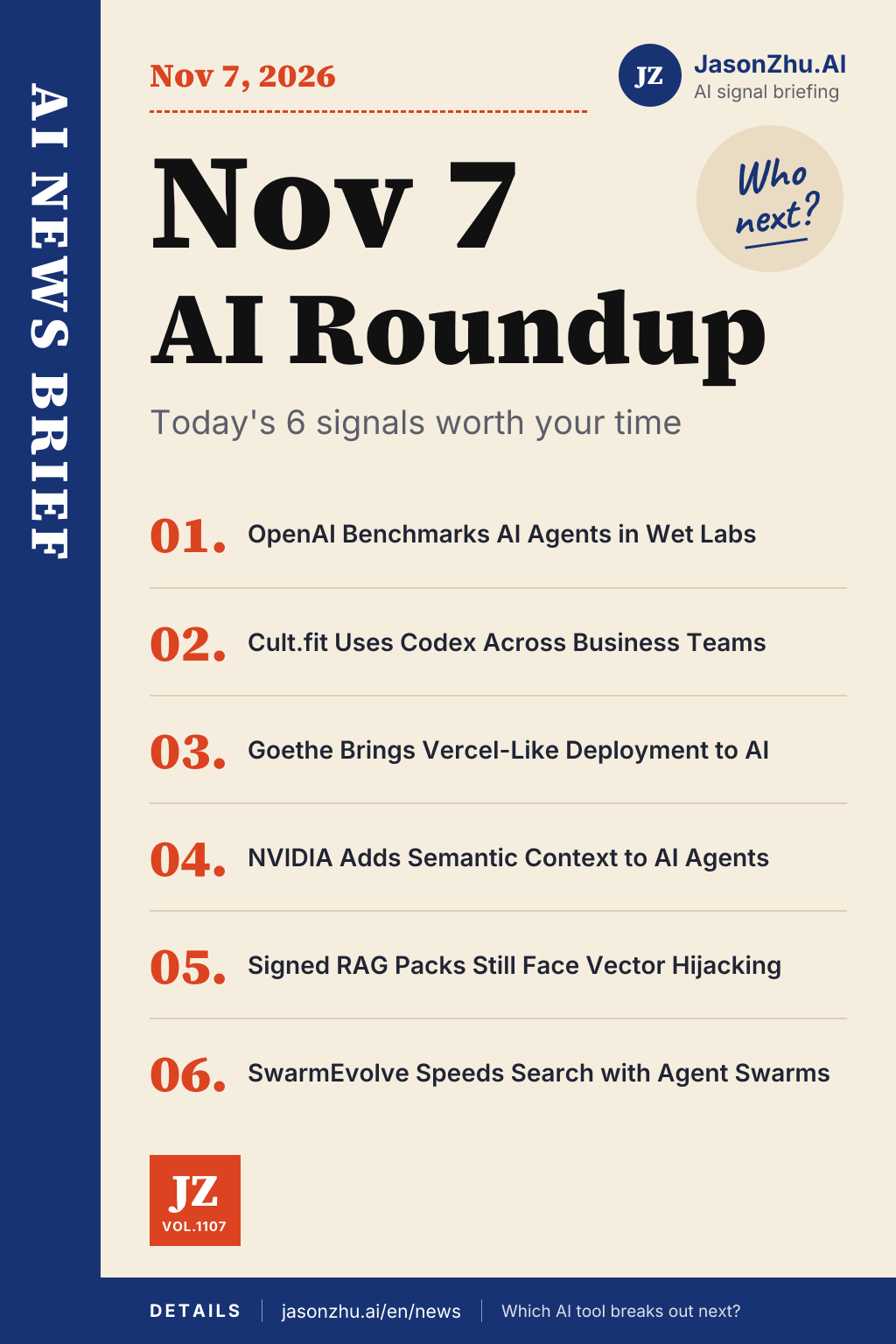
OpenAI Benchmarks AI Agents in Wet Labs↗

OpenAI introduced BioBasicsBench, a 100-task benchmark for evaluating AI agents on everyday wet-lab science, including raw experimental data interpretation and experimental procedures. It gives developers a more realistic way to measure scientific agents beyond text-only reasoning, while highlighting the gap between understanding experiments and reliably supporting real laboratory workflows.

🚀
Going GlobalOpenAI Blog

Cult.fit Uses Codex Across Business Teams↗

Indian fitness and wellness platform Cult.fit is using Codex across business functions to build internal tools and accelerate delivery. The case shows that coding agents can create value beyond replacing developer tasks: they can expand software-building capabilities to operations, product, and other non-engineering teams.

🛠️
AI ToolsHacker News

Goethe Brings Vercel-Like Deployment to AI↗

Goethe is an open-source platform for deploying AI models on hardware users control themselves. It manages models and machines, selects suitable inference setups, and exposes secure APIs, aiming to provide a Vercel-like experience for self-hosted AI. Its appeal is reducing the operational burden of private and on-premise inference.

🔥
SkillsGitHub Trending

NVIDIA Adds Semantic Context to AI Agents↗

NVIDIA released Auto Ontology, a Python framework that builds semantic graph layers over enterprise data. It helps agents understand where data lives, what metrics mean, and how they should be queried, enabling more deterministic retrieval and explainable reasoning. Developers can use it as a context layer for analytics agents, RAG systems, and database assistants.

📚
AI PapersHuggingFace Papers

Signed RAG Packs Still Face Vector Hijacking↗

The paper shows that signatures on offline RAG knowledge packs prove publisher identity but not whether embeddings actually match the signed text. An attacker controlling vectors may redirect retrieval toward malicious content. Developers deploying edge or offline RAG systems should verify both signatures and text-vector consistency instead of trusting signed metadata alone.

📚
AI PapersHuggingFace Papers

SwarmEvolve Speeds Search with Agent Swarms↗

SwarmEvolve uses hundreds of inexpensive agents in parallel to evolve programs for mathematical and computational tasks. Instead of repeatedly producing long reasoning traces, agents search in latent space, reducing cost and latency. The approach suggests a practical architecture for high-throughput code optimization, experiment discovery, and automated algorithm search.

🛠️
AI ToolsTechCrunch AI

Hundreds of Artex AI Hacking Servers Exposed↗

Security researchers found hundreds of servers running the Artex penetration-testing tool exposed directly to the public internet. Anyone could potentially access the AI-assisted hacking capability. The incident highlights a growing operational risk: security agents and automation tools require strict network isolation, authentication, and permission controls to avoid becoming attack infrastructure.

💰AI Funding Roundup

Shield AI↗

Growth round$2B

Shield AI builds autonomous flight and defense AI systems and landed the week's largest raise, showing that AI-driven defense and physical autonomy remain a top priority for investors.

Zipline International↗

Growth round$1.5B

Zipline delivers goods using AI and autonomous drones, and its large raise reflects the commercial potential of smart hardware in real-world logistics.

Subscribe for daily AI updates + free playbook

📘 Subscribe Free