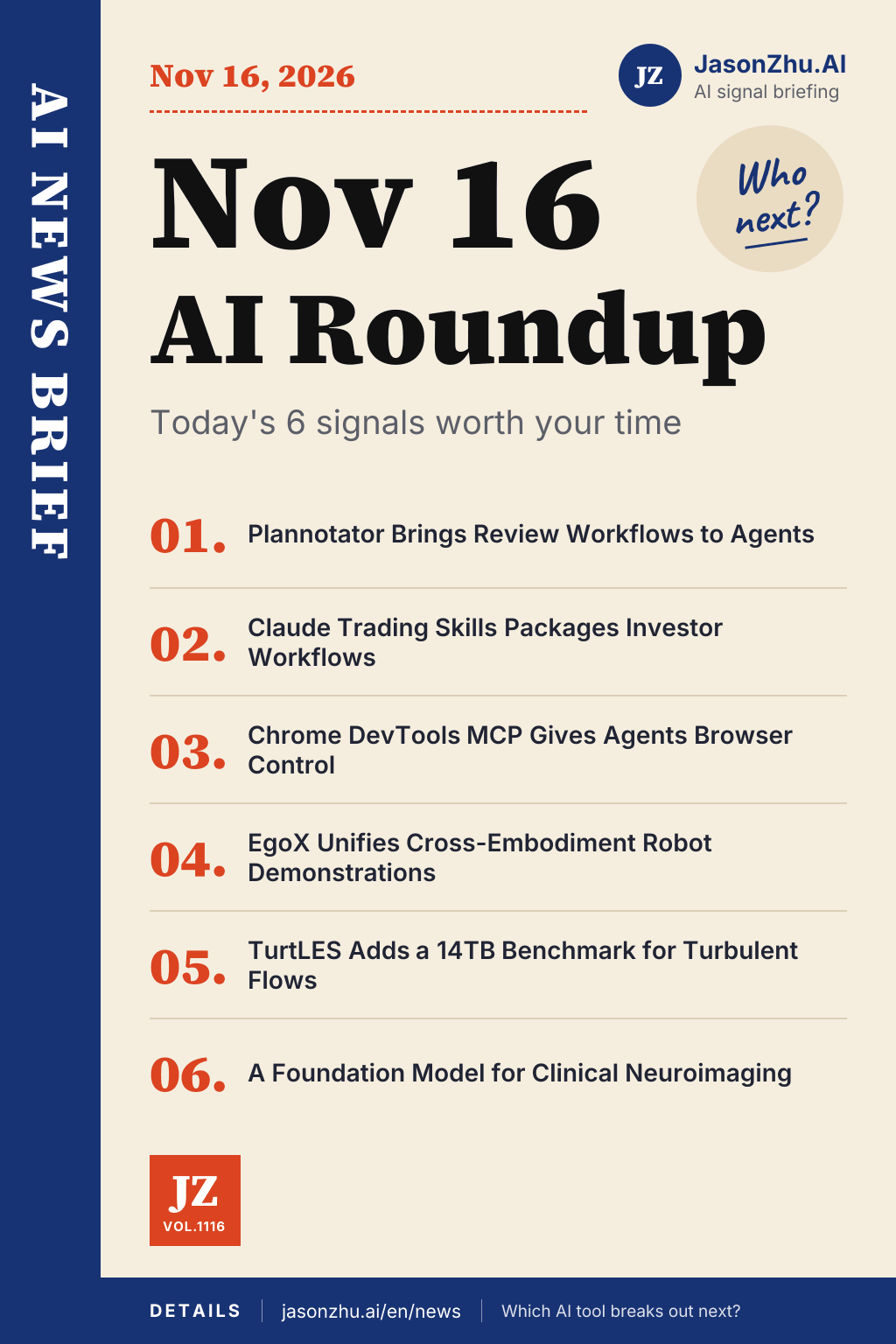
AI News · 2026-11-16

· JasonZhu.AI · Compiled by AI

AI News · 2026-11-16

AI summary · this digest is compiled by AI, not yet reviewed by Jason

The key trend is that browser MCP and vertical Skills are maturing together, moving agents from generating code toward using tools, receiving review, and completing professional workflows.

🔥
SkillsGitHub Trending

Plannotator Brings Review Workflows to Agents↗

Plannotator provides a workspace for annotating agent plans, specifications, interactive artifacts, code diffs, and pull requests. Feedback can be sent back to the coding agent in one click. The project matters because it adds a structured human review layer to increasingly autonomous software development workflows.

🔥
SkillsGitHub Trending

Claude Trading Skills Packages Investor Workflows↗

Claude Trading Skills is a toolkit for individual investors covering market analysis, technical charting, economic calendars, screeners, and strategy development. Its importance lies in showing how Claude Skills can package domain expertise and repeatable workflows into an agent without retraining the underlying model.

🔥
SkillsGitHub Trending

Chrome DevTools MCP Gives Agents Browser Control↗

Chrome DevTools MCP exposes live browser control through both an MCP server and a CLI. Coding agents such as Claude, Cursor, and Copilot can inspect pages, debug issues, automate interactions, and analyze performance. This moves agent coding beyond code generation toward a run-observe-fix loop.

📚
AI PapersHuggingFace Papers

EgoX Unifies Cross-Embodiment Robot Demonstrations↗

EgoX introduces a framework for learning manipulation across humans, real robots, and simulated agents by aligning semantically corresponding observations and actions. For developers, the key value is better reuse of heterogeneous demonstrations, potentially reducing the data and engineering cost of training general-purpose robotic policies.

📚
AI PapersHuggingFace Papers

TurtLES Adds a 14TB Benchmark for Turbulent Flows↗

TurtLES introduces a 14TB benchmark for machine-learning surrogates of three-dimensional turbulent flows, with 400 trajectories and millions of points per frame. It gives developers a more realistic way to evaluate whether AI models can generalize beyond simple simulation settings and accelerate computational fluid dynamics reliably.

📚
AI PapersHuggingFace Papers

A Foundation Model for Clinical Neuroimaging↗

This work explores a general machine-intelligence system for human neuroimaging that goes beyond narrow image interpretation. The goal is to analyze complex examinations and communicate findings in clinical decision contexts. For developers, it highlights the shift toward integrating private medical data, domain context, and real clinical workflows.

Subscribe for daily AI updates + free playbook

📘 Subscribe Free