AI News · 2026-11-19

· JasonZhu.AI · Compiled by AI

AI News · 2026-11-19

AI summary · this digest is compiled by AI, not yet reviewed by Jason

Coding agents are moving beyond standalone generation toward controlled workflows, making cross-platform research skills, self-hosted orchestration, and sandbox permissions important implementation areas for developers.

🔥
SkillsGitHub Trending

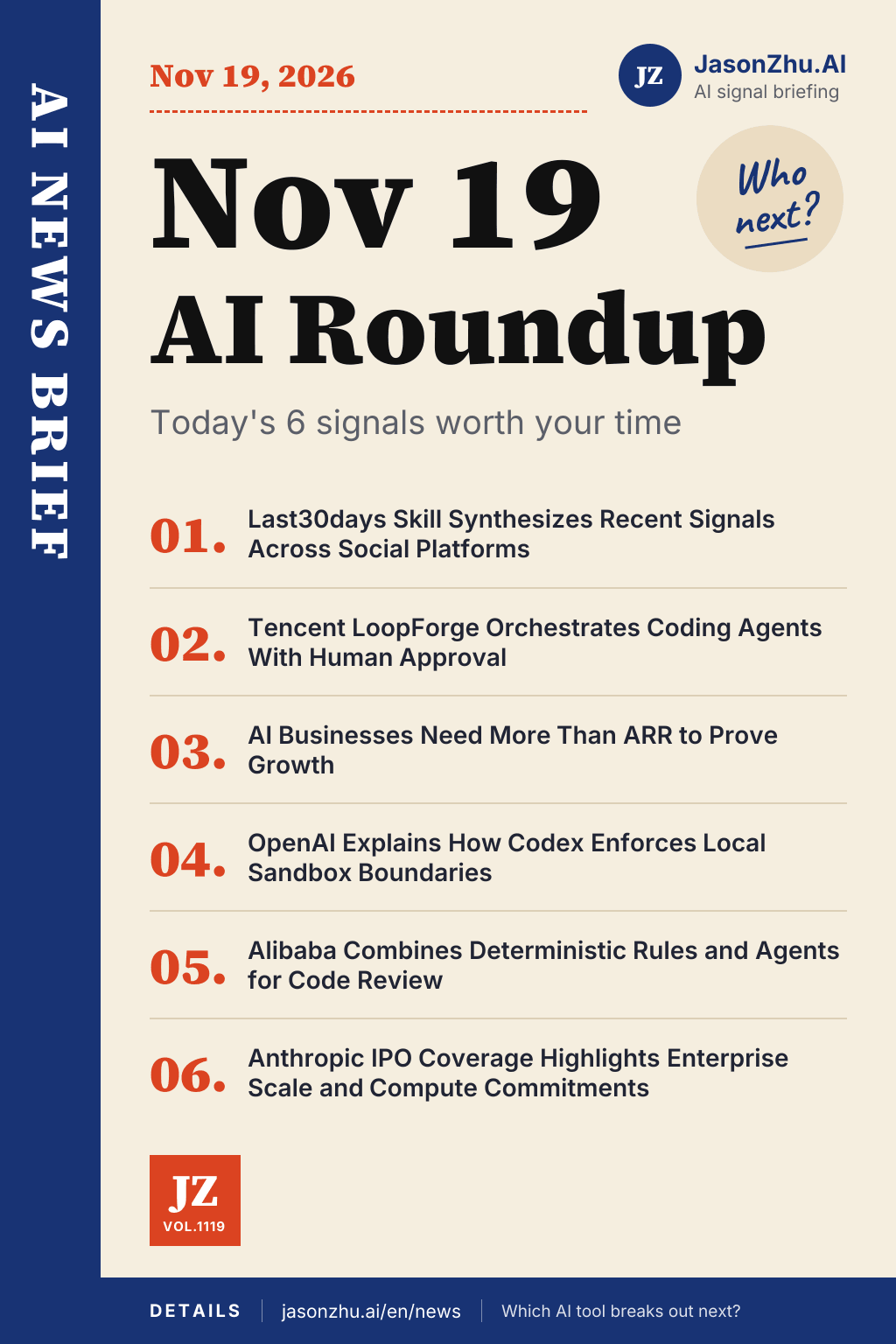
Last30days Skill Synthesizes Recent Signals Across Social Platforms↗

The last30days skill lets an AI agent research topics across Reddit, X, YouTube, Hacker News, Polymarket, and the web, then synthesize a grounded summary. Its pipeline incorporates community engagement and market signals, offering developers a reusable starting point for recent demand discovery and competitor research rather than manually checking each platform.

🔥
SkillsGitHub Trending

Tencent LoopForge Orchestrates Coding Agents With Human Approval↗

Tencent's LoopForge is a self-hosted workspace for coding-agent delivery, orchestrating CodeBuddy, Codex, and Claude Code through scripts and human approval gates. It also includes local workflows for coding assistants. For development teams, the practical value is connecting code generation to controlled delivery processes rather than adding another standalone chat interface.

💰
MonetizationCrunchbase News

AI Businesses Need More Than ARR to Prove Growth↗

Investor Kenza Zayani argues that subscription, usage-based, and outcome-based pricing can make headline ARR a poor proxy for predictable AI revenue. Founders seeking growth capital should also demonstrate retention, customer expansion, revenue predictability, and sustainable margins. The takeaway is to distinguish durable customer commitments from spending patterns that merely produce an attractive annualized figure.

🛠️
AI ToolsOpenAI Blog

OpenAI Explains How Codex Enforces Local Sandbox Boundaries↗

OpenAI details how Codex executes commands on local machines while enforcing user-controlled filesystem and network restrictions across macOS, Linux, and Windows. For teams adopting coding agents, the explanation helps clarify what access automated workflows receive and where sandbox boundaries apply. It describes execution safeguards rather than establishing a blanket guarantee of safe agent behavior.

🛠️
AI ToolsGitHub Trending

Alibaba Combines Deterministic Rules and Agents for Code Review↗

Alibaba's OpenCodeReview combines deterministic pipelines with an LLM agent to produce line-level review comments. Its built-in multilingual rules cover issues including null pointers, thread safety, XSS, and SQL injection, with compatibility for OpenAI and Anthropic interfaces. The hybrid approach gives teams a way to combine explicit checks with model-assisted review using existing model services.

🛠️
AI ToolsCrunchbase News

Anthropic IPO Coverage Highlights Enterprise Scale and Compute Commitments↗

Crunchbase's analysis of Anthropic's IPO filing reports $17 billion in revenue and more than 11,900 customers spending at least $100,000 annually. The filing also reveals enormous computing commitments. Together, these figures illustrate substantial enterprise demand while raising questions about whether rapid revenue growth can support the company's long-term infrastructure obligations and associated risks.

📚
AI PapersHuggingFace Papers

WeightBench Tests Language Models as Neural Network Editors↗

WeightBench introduces 42 tasks for evaluating whether language models can read, repair, or write other neural networks directly through their parameters, without gradient descent. For developers, it provides a structured way to test model-editing capabilities beyond ordinary code generation. The benchmark investigates an emerging approach; it does not establish that conventional training can broadly be replaced.

📚
AI PapersHuggingFace Papers

CADMAGEDDON Reconstructs Editable CAD With Local Inference↗

CADMAGEDDON is an open-source agent that reconstructs editable CAD from meshes and can run locally on single-GPU systems and current-generation laptops. It breaks reconstruction into a sequence of simpler visual decisions. For developers building engineering tools, the practical appeal is supporting proprietary part workflows without requiring customers to send their geometry to external services.

Subscribe for daily AI updates + free playbook

📘 Subscribe Free