AI News · 2026-11-22

· JasonZhu.AI · Compiled by AI

AI News · 2026-11-22

AI summary · this digest is compiled by AI, not yet reviewed by Jason

OpenAI revealed early GPT-6 Astra financial research results via Hebbia, while coding agents and LLMs are expanding into automated security auditing and gradient-free self-weight rewriting.

🛠️
AI ToolsOpenAI Blog

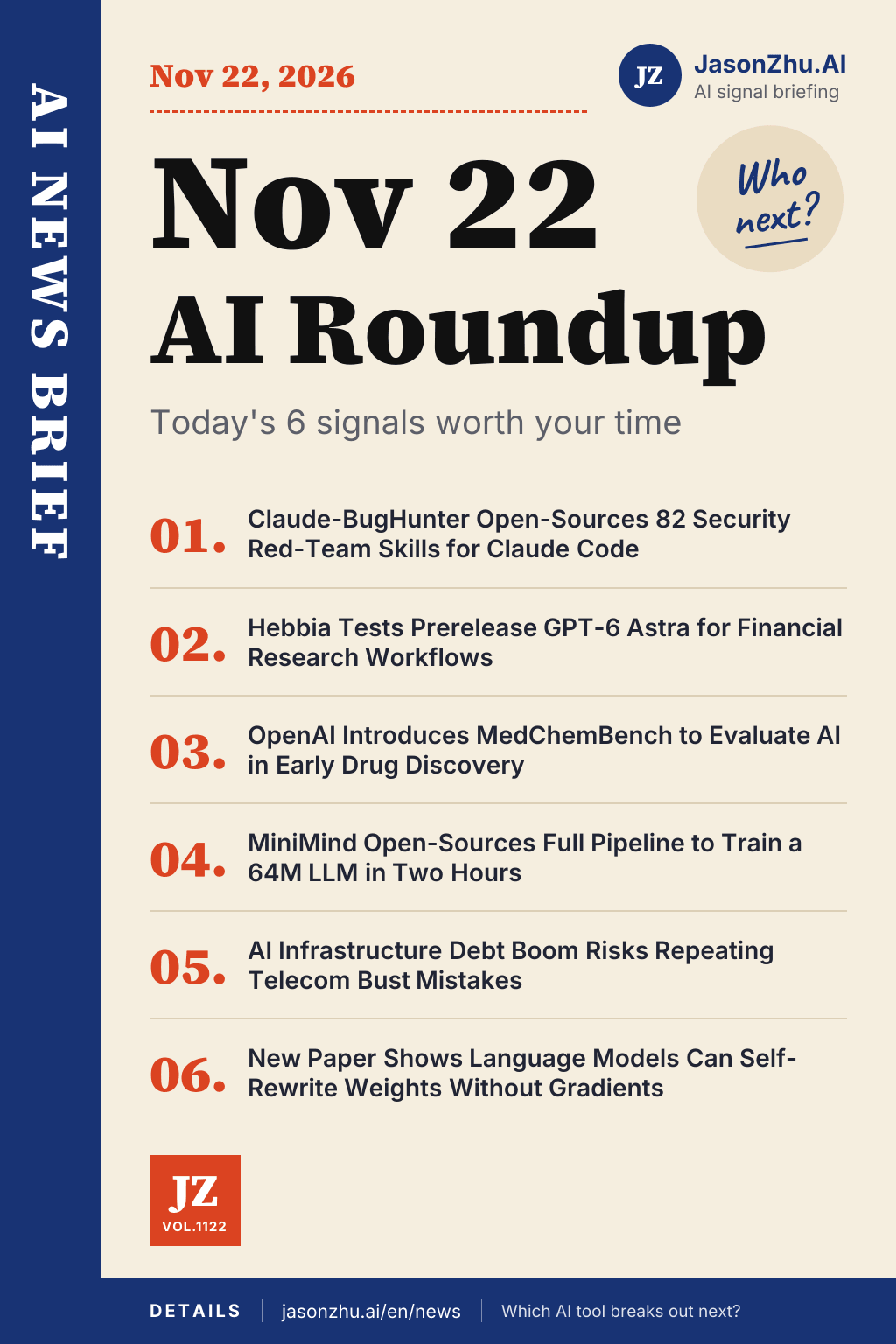
Hebbia Tests Prerelease GPT-6 Astra for Financial Research Workflows↗

OpenAI shared prerelease evaluation results from financial AI platform Hebbia testing GPT-6 Astra. In complex financial research workflows, the model delivered measurable gains in source coverage, citation relevance, and presentation quality, highlighting stronger reliability for high-stakes enterprise analysis.

🛠️
AI ToolsOpenAI Blog

OpenAI Introduces MedChemBench to Evaluate AI in Early Drug Discovery↗

OpenAI launched MedChemBench, a new benchmark designed to evaluate how effectively AI models interpret molecular structures, reason from experimental evidence, and select promising compounds in early drug discovery, giving life-science AI builders a standardized evaluation yardstick.

🛠️
AI ToolsGitHub Trending

MiniMind Open-Sources Full Pipeline to Train a 64M LLM in Two Hours↗

MiniMind enables developers to train a 64M-parameter language model from scratch on consumer GPUs in roughly two hours at minimal cost. It open-sources the full stack—including MoE, SFT, LoRA, DPO, GRPO, and Agentic RL—making it an accessible hands-on learning toolkit.

🛠️
AI ToolsCrunchbase News

AI Infrastructure Debt Boom Risks Repeating Telecom Bust Mistakes↗

A Crunchbase guest analysis warns that the AI buildout's growing reliance on debt mirrors the telecom bubble. Even if AI delivers technologically, borrowers risk restructuring or bankruptcy if infrastructure spending outpaces realistic demand forecasts and dependable cash flows.

📚
AI PapersHuggingFace Papers

New Paper Shows Language Models Can Self-Rewrite Weights Without Gradients↗

Deployed models typically have frozen weights and cannot retain prompt-level fixes across tasks. This paper shows language models can inspect their own weights and graded answers to rewrite weights purely through reasoning—without gradients or retraining—pointing toward self-improving deployed systems.

📚
AI PapersHuggingFace Papers

Lang-SVG Uses Language Priors to Generate Semantic, Editable Vector Graphics↗

Existing image vectorizers optimize pixel fidelity but output messy SVG code lacking human-aligned structure. Lang-SVG introduces an explicit semantic tree using language priors to organize SVG primitives into logical object-part hierarchies, making AI-generated vector graphics genuinely editable for designers and frontend developers.

📚
AI PapersHuggingFace Papers

Coding Agents Train Optical Neural Networks In Situ via Code↗

Optical neural networks offer fast, low-energy compute, yet hardware imperfections traditionally require expert-built digital calibration models. This paper introduces 'optics as code,' enabling coding agents to directly train physical optical hardware in situ, lowering the barrier to programming next-generation AI hardware.

Subscribe for daily AI updates + free playbook

📘 Subscribe Free