AI News · 2026-11-25

· JasonZhu.AI · Compiled by AI

AI News · 2026-11-25

AI summary · this digest is compiled by AI, not yet reviewed by Jason

OpenAI's pretraining curve release and Shirudo open-sourcing, alongside Beam and Superpowers, highlight growing momentum in model transparency and practical agent engineering.

🔥
SkillsGitHub Trending

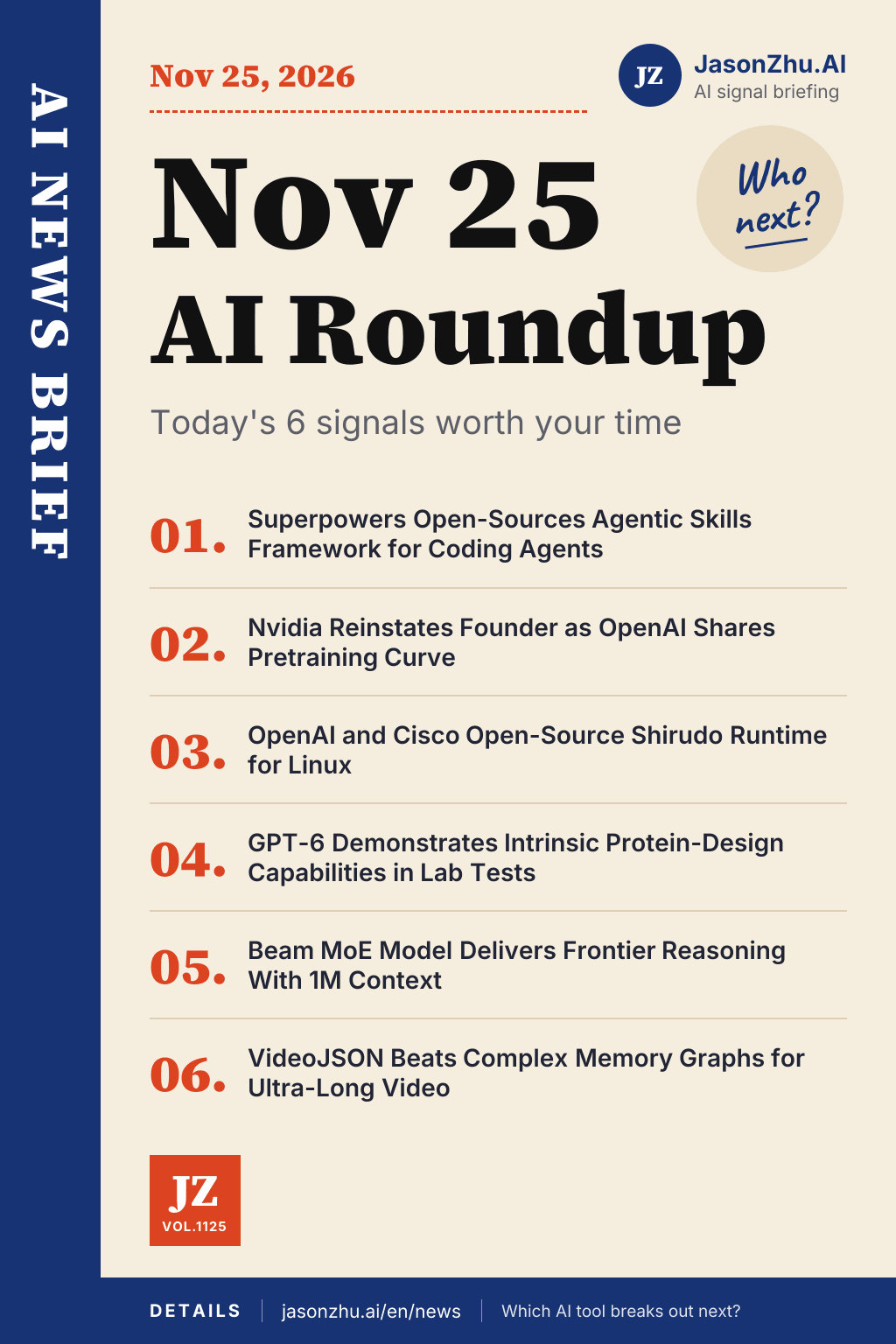
Superpowers Open-Sources Agentic Skills Framework for Coding Agents↗

Superpowers provides a composable agentic skills framework and structured software development methodology for coding agents including Claude Code, Cursor, Codex CLI, and Gemini. By pairing modular skills with strict initial instructions, it helps developers standardize how agents plan, build, and verify code across complex engineering workflows.

🛠️
AI ToolsLatent Space

Nvidia Reinstates Founder as OpenAI Shares Pretraining Curve↗

Nvidia has reinstated its founder, marking a major leadership turn for the AI chipmaker. Meanwhile, OpenAI published its internal pretraining loss curve and, joined by Microsoft, proposed a shared training limit, offering rare transparency into scaling laws and emerging industry guardrails for frontier compute.

🛠️
AI ToolsOpenAI Blog

OpenAI and Cisco Open-Source Shirudo Runtime for Linux↗

OpenAI and Cisco have introduced Shirudo, an open-source Linux runtime designed to protect running systems while security patches are being rolled out. For infrastructure and security teams, it reduces exposure during patch windows and helps keep production workloads safe without immediate downtime.

🛠️
AI ToolsOpenAI Blog

GPT-6 Demonstrates Intrinsic Protein-Design Capabilities in Lab Tests↗

OpenAI revealed that GPT-6 models can intrinsically design protein structures and sequences using reasoning and code generation. Laboratory experiments found binding evidence across five targets, highlighting how general-purpose frontier models are moving beyond text and coding into verifiable wet-lab biological engineering.

📚
AI PapersHuggingFace Papers

Beam MoE Model Delivers Frontier Reasoning With 1M Context↗

Beam is a 501.3B-total, 23.4B-active sparse MoE model engineered for coding, reasoning, and agentic workloads with a 1M-token context window. By achieving frontier reasoning with three to four times less inference compute, it gives developers a far more cost-efficient backbone for long-context agents.

📚
AI PapersHuggingFace Papers

VideoJSON Beats Complex Memory Graphs for Ultra-Long Video↗

Instead of relying on rigid memory graphs for multi-day video search, VideoJSON indexes each minute into a minimal JSON record and lets a coding agent write custom search programs. For developers, this shows that simple structured indexes paired with agent-written code can outperform complex memory pipelines.

📚
AI PapersHuggingFace Papers

Frontier Models Unmask Human or AI Authors From One Text↗

Without tools or reference samples, frontier models such as Claude Fable 5.2, GPT-6.1 Sol, and Gemini 4 Carbon can identify from a single text whether a human or AI wrote it, which lab built it, and often which person authored it—highlighting new stakes for content attribution and anonymity.

📚
AI PapersHuggingFace Papers

SMB Bench Tests AI Agents on Delayed Operational Consequences↗

SMB Bench introduces a calibrated 90-day wholesale simulator to test how language model agents handle decisions whose consequences unfold weeks later, such as lost customers and cash crunches. For developers building autonomous business agents, it provides a realistic benchmark beyond isolated single-turn tasks.

Subscribe for daily AI updates + free playbook

📘 Subscribe Free