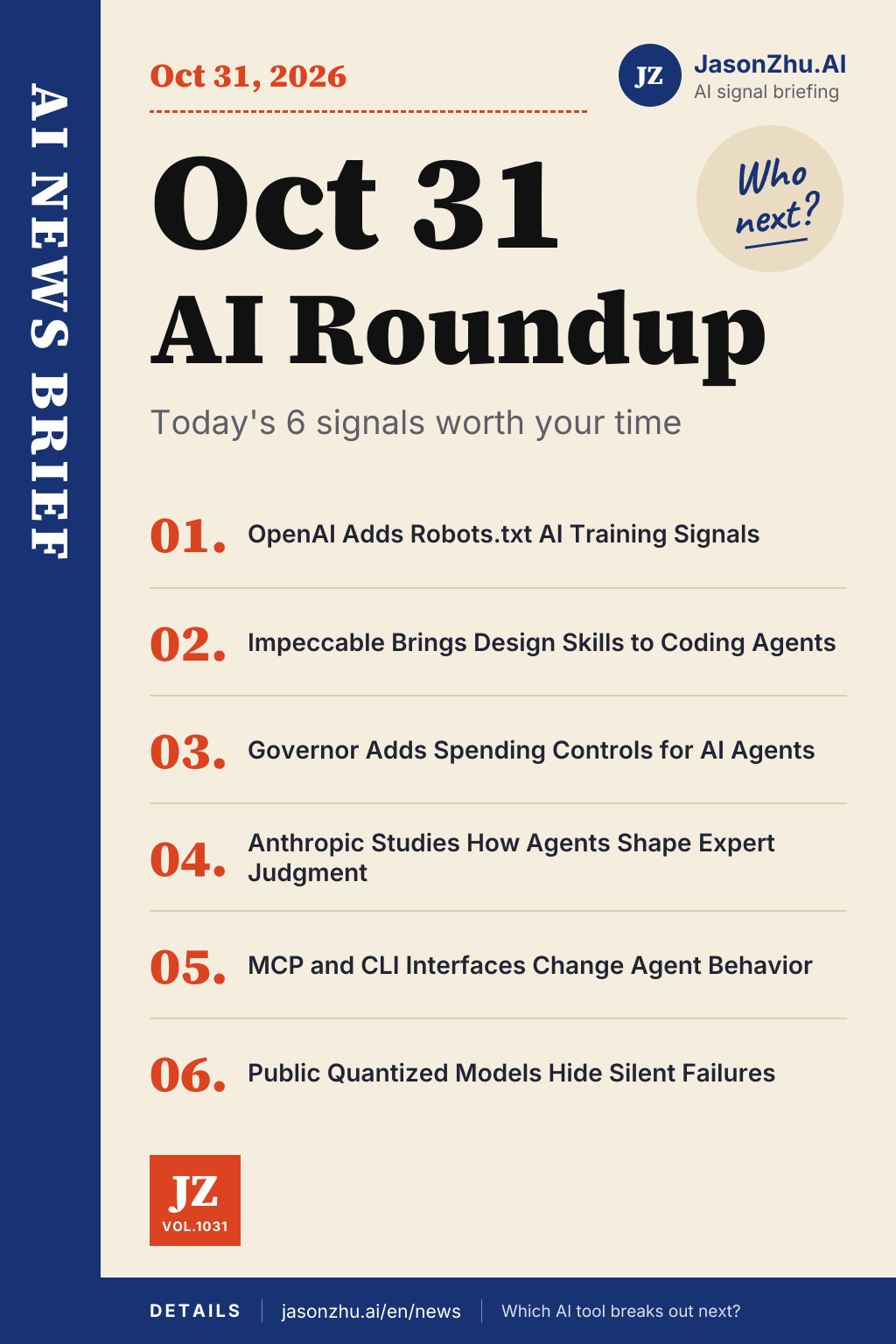
AI News · 2026-10-31

· JasonZhu.AI · Compiled by AI

AI News · 2026-10-31

AI summary · this digest is compiled by AI, not yet reviewed by Jason

The key development today is that agent interfaces and runtime controls are becoming core engineering concerns, directly shaping behavior, cost, and reliability.

🛠️
AI ToolsOpenAI Blog

OpenAI Adds Robots.txt AI Training Signals↗

OpenAI will honor a shared robots.txt signal that lets website operators communicate AI training preferences to participating providers. The move could create a more standardized mechanism for content permissions and give publishers a clearer way to manage how their data is used in model development.

🔥
SkillsGitHub Trending

Impeccable Brings Design Skills to Coding Agents↗

Impeccable packages design vocabulary, visual refinement, critique, and audits into installable skills for coding agents such as Claude Code and Cursor. It targets the repetitive, low-polish interfaces often produced by AI, giving developers a reusable vocabulary and workflow for improving frontend quality.

🔥
SkillsHacker News

Governor Adds Spending Controls for AI Agents↗

Governor is presented as a firewall for AI-agent tool calls and spending. It aims to help teams restrict risky actions, control API costs, and monitor execution behavior. As agents gain more autonomy, runtime policy layers like this are becoming increasingly important for production deployments.

🛠️
AI ToolsAnthropic Research

Anthropic Studies How Agents Shape Expert Judgment↗

Anthropic examines how AI agents influence experts’ judgment calls in complex work, focusing on trust, responsibility, and decision boundaries in human-agent collaboration. The findings highlight that agent products need explicit authorization, review, and accountability mechanisms rather than treating agents as simple automation tools.

📚
AI PapersHuggingFace Papers

MCP and CLI Interfaces Change Agent Behavior↗

This controlled study gives agents identical capabilities through MCP and command-line interfaces, then measures behavioral differences. It shows that tool design is not merely an integration detail: command structure, parameter presentation, and context organization can directly influence agent choices and reliability.

📚
AI PapersHuggingFace Papers

Public Quantized Models Hide Silent Failures↗

Researchers tested quantized GGUF models from Ollama and Hugging Face and found that some files loaded successfully but performed almost no useful coding work. For developers, this means format compatibility is not functional reliability; deployment pipelines need automated capability tests and regression checks.

📚
AI PapersHuggingFace Papers

New Method Enables Any-Order Image Generation↗

The paper proposes a way to free autoregressive image models from a fixed raster-scan order without training separately for every ordering. This makes inpainting, outpainting, and editing more natural, potentially allowing developers to support multiple image operations within a more unified model.

Subscribe for daily AI updates + free playbook

📘 Subscribe Free