AI News · 2026-11-01

· JasonZhu.AI · Compiled by AI

AI News · 2026-11-01

AI summary · this digest is compiled by AI, not yet reviewed by Jason

The key trend today is the shift from one-shot conversations to long-running agents, with persistent memory, recoverable execution, and verifiable evaluation becoming essential for deployment.

🔥
SkillsGitHub Trending

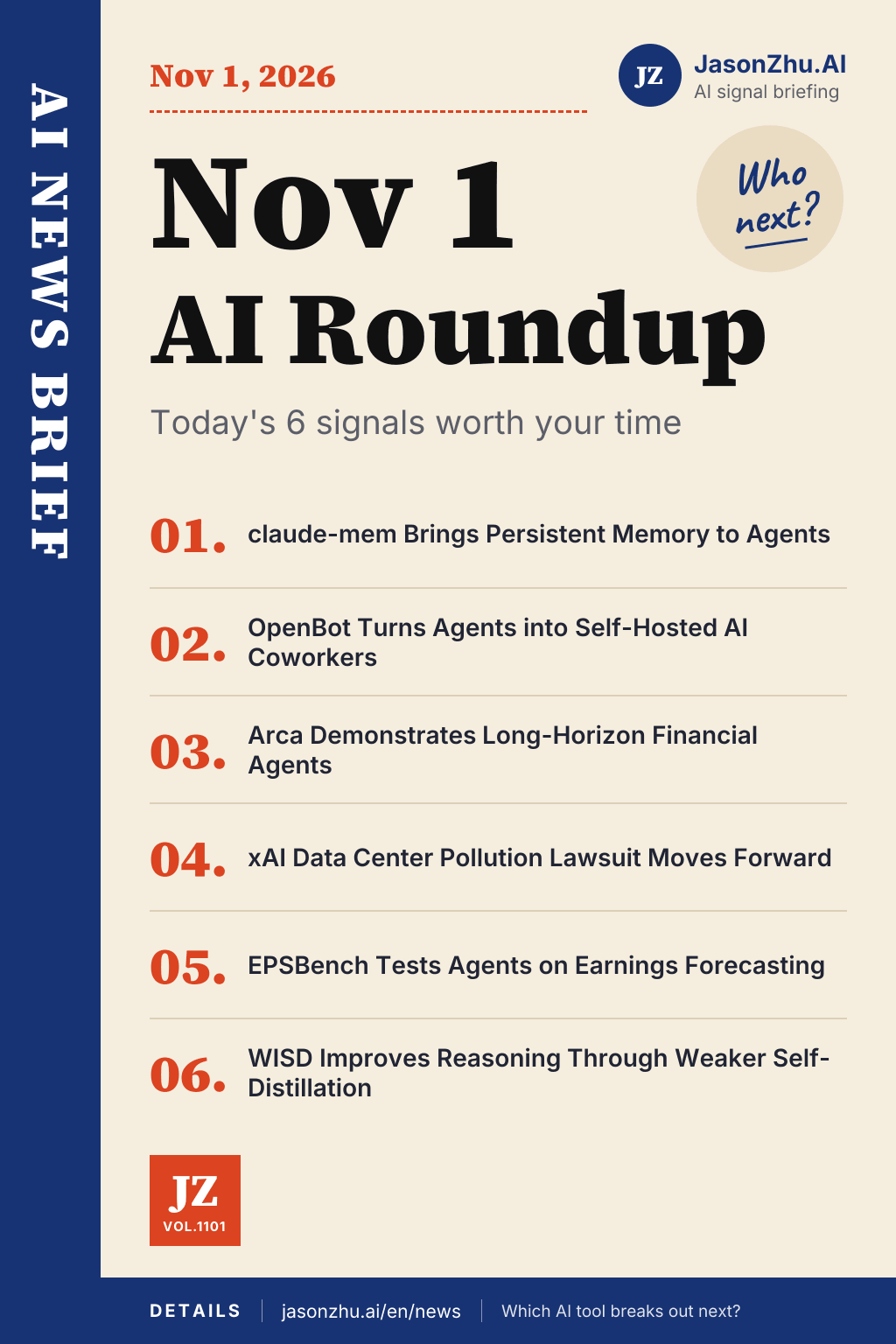
claude-mem Brings Persistent Memory to Agents↗

claude-mem records agent activity, compresses it with AI, and injects relevant context into future sessions across Claude Code, Codex, Gemini, and other tools. It addresses the costly loss of project context between sessions, providing a reusable memory layer for long-running coding and automation workflows.

🛠️
AI ToolsGitHub Trending

OpenBot Turns Agents into Self-Hosted AI Coworkers↗

CopilotKit’s open-source OpenBot gives each AI coworker its own browser, files, and tools while recording decisions before and after actions. Supporting AG-UI and multiple agent stacks, it lets companies run customizable ChatGPT-like assistants on their own infrastructure, reducing data exposure and vendor lock-in.

🛠️
AI ToolsLatent Space

Arca Demonstrates Long-Horizon Financial Agents↗

Arca’s AI team describes financial research agents that operate across multiple days using persistent memory, a custom harness, and long-running workflows. The case study shows that reliable complex agents depend not only on model quality, but also on state management, tool orchestration, and recoverable execution.

🛠️
AI ToolsTechCrunch AI

xAI Data Center Pollution Lawsuit Moves Forward↗

A judge allowed the NAACP’s lawsuit over pollution from an xAI data center to proceed. The organization alleges violations of the Clean Air Act. The case brings the environmental costs of AI infrastructure expansion into judicial scrutiny and could affect permitting, compliance, and operating costs for energy-intensive data centers.

📚
AI PapersHuggingFace Papers

EPSBench Tests Agents on Earnings Forecasting↗

EPSBench evaluates agents on 149 quarters across 86 companies, requiring them to extract evidence from filings, earnings calls, and news before estimating income-statement drivers. It separates merely summarizing financial documents from performing auditable financial reasoning, offering a practical reliability test for finance-oriented agents.

📚
AI PapersHuggingFace Papers

WISD Improves Reasoning Through Weaker Self-Distillation↗

WISD improves a reasoning model without requiring an external teacher or labeled answers. It creates a weakened version of the model and uses the performance gap between the original and weakened versions as a training signal. This could make reasoning improvements cheaper when high-quality supervision is unavailable.

📚
AI PapersHuggingFace Papers

Unified Training Reframes Foundation Model Development↗

The paper argues that pretraining, midtraining, supervised fine-tuning, and reinforcement learning can be expressed as variants of one likelihood-based objective over model-generated target distributions. If validated, this could simplify training pipelines and give developers a clearer view of what each stage is actually optimizing.

🛠️
AI ToolsOpenAI Blog

OpenAI Adds Stronger Protections for Teen Users↗

OpenAI published a community safety report and announced stronger protections for teen users, including earlier risk detection, expanded interventions, and greater public reporting. The update reflects a broader shift in mainstream chat products from reactive blocking toward continuous risk monitoring and safety operations.

Subscribe for daily AI updates + free playbook

📘 Subscribe Free