AI News · 2026-11-02

· JasonZhu.AI · Compiled by AI

AI News · 2026-11-02

AI summary · this digest is compiled by AI, not yet reviewed by Jason

The key development today is the maturation of the Skills ecosystem, expanding from prompt collections into full workflow orchestration, team coordination, and cross-device control for coding agents.

🔥
SkillsGitHub Trending

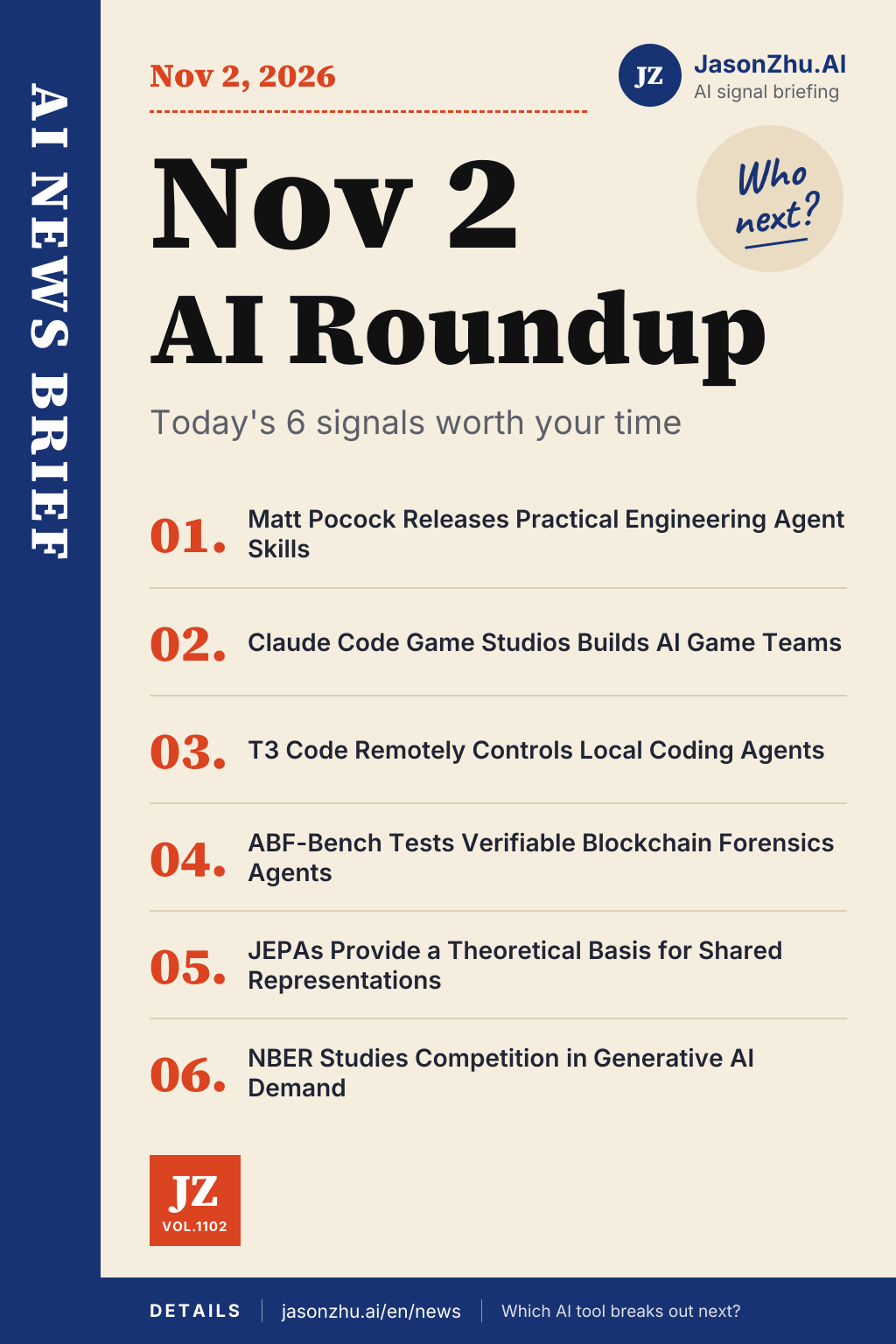
Matt Pocock Releases Practical Engineering Agent Skills↗

Matt Pocock has open-sourced a collection of practical engineering skills designed for daily agent-assisted development. The skills emphasize small, adaptable components rather than rigid methodologies that take control away from developers. This offers Claude Code users reusable workflows while preserving human oversight and debugging flexibility.

🔥
SkillsGitHub Trending

Claude Code Game Studios Builds AI Game Teams↗

Claude Code Game Studios turns a single coding session into a coordinated game-development organization with 49 agents, 74 workflow skills, and a studio-like hierarchy. It covers tasks across design, planning, and implementation, illustrating how Skills are evolving from isolated assistance into structured orchestration for complex projects.

🔥
SkillsGitHub Trending

T3 Code Remotely Controls Local Coding Agents↗

T3 Code provides mobile, web, and desktop control surfaces for coding agents running on a user’s own machine. It supports Claude Code, Codex, Cursor, Grok Build, OpenCode, and others without replacing existing subscriptions, making multi-agent development easier to supervise across devices.

📚
AI PapersHuggingFace Papers

ABF-Bench Tests Verifiable Blockchain Forensics Agents↗

ABF-Bench introduces an interactive benchmark for blockchain-forensics agents. Models must trace funds through laundering, bridging, swapping, and mixing scenarios while producing independently verifiable evidence. For developers, it offers a more realistic way to evaluate tool-using agents than conventional question-answer tests.

📚
AI PapersHuggingFace Papers

JEPAs Provide a Theoretical Basis for Shared Representations↗

This work turns the Platonic Representation Hypothesis into a theorem for JEPA-style models: separately trained models across modalities can learn equivalent representations up to a rotation. For developers, the result suggests that multimodal alignment may rely more on shared latent structure and less on massive paired datasets.

📚
AI PapersHacker News

NBER Studies Competition in Generative AI Demand↗

A new NBER study examines competition in generative AI through consumer demand, focusing on how users choose among products and how capabilities, pricing, and positioning affect market share. The practical implication is that winning AI products require more than model quality: they must match concrete user needs and usage contexts.

Subscribe for daily AI updates + free playbook

📘 Subscribe Free