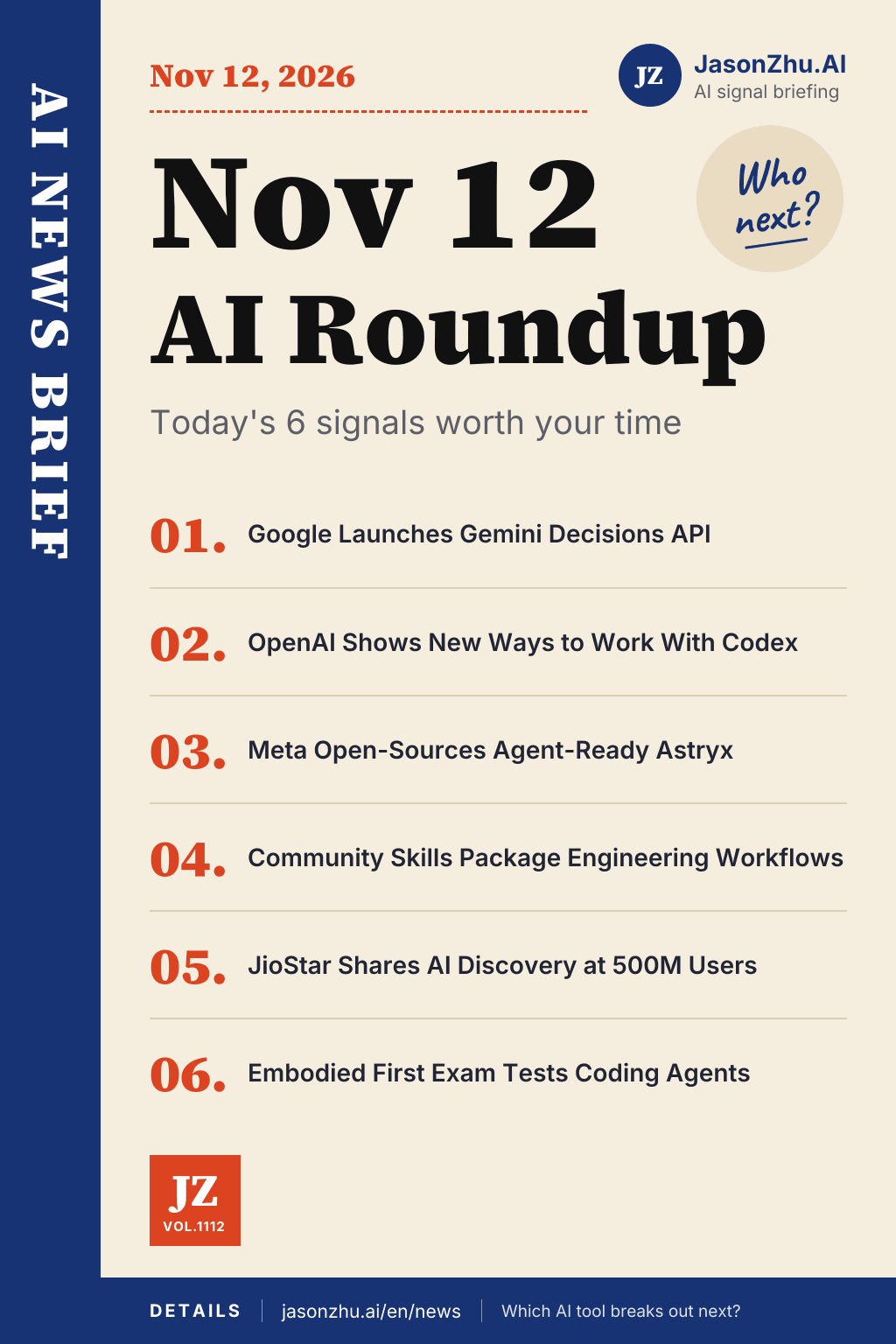
AI News · 2026-11-12

· JasonZhu.AI · Compiled by AI

AI News · 2026-11-12

AI summary · this digest is compiled by AI, not yet reviewed by Jason

The key trend is AI development shifting from code generation toward delegatable, reusable, and verifiable agent workflows, led by Codex and the growing engineering Skills ecosystem.

🛠️
AI ToolsGoogle AI Blog

Google Launches Gemini Decisions API↗

Google introduced the Gemini Decisions API for fast, calibrated multimodal decisions. Instead of building separate classification and confidence-calibration pipelines, developers can use a dedicated interface for business automation, visual inspection, routing, and other applications that require reliable decisions rather than open-ended text generation.

🛠️
AI ToolsLatent Space

OpenAI Shows New Ways to Work With Codex↗

At the AI Engineer Code Summit, OpenAI demonstrated voice control for Codex, cloud handoffs, and new collaboration workflows. The direction is significant because Codex is moving beyond one-shot code generation toward asynchronous delegation, where developers describe intent, review progress, and let remote agents complete longer tasks.

🛠️
AI ToolsGitHub Trending

Meta Open-Sources Agent-Ready Astryx↗

Meta open-sourced Astryx, a customizable design system built with React 19 and StyleX. Developed internally over eight years, it is designed for both humans and agents. The project could help teams standardize interfaces while giving coding agents reusable components and clearer constraints for frontend implementation.

🔥
SkillsGitHub Trending

Community Skills Package Engineering Workflows↗

Addy Osmani’s agent-skills repository packages senior engineering practices into reusable skills covering definition, planning, building, verification, review, and shipping. This matters because teams can encode quality gates and repeatable workflows for coding agents instead of relying on fragile, one-off prompts.

🛠️
AI ToolsOpenAI Blog

JioStar Shares AI Discovery at 500M Users↗

JioStar’s chief architect described deploying AI discovery for an audience of 500 million users, highlighting evaluations, guardrails, and production operations. The case shows that large-scale AI products depend not only on model quality, but also on continuous testing, safety controls, and reliable serving infrastructure.

📚
AI PapersHuggingFace Papers

Embodied First Exam Tests Coding Agents↗

Embodied First Exam introduces an agent-native benchmark for robotics in which coding agents choose their own control strategies under physical-world constraints. For developers, it separates the ability to generate control code from the harder requirement of reliably executing safe, effective actions across different robot platforms.

📚
AI PapersHuggingFace Papers

Dynamic Remasking Improves Diffusion LM Reasoning↗

The paper proposes frequency-aware remasking for diffusion language models, allocating more inference computation to difficult problems instead of using a fixed decoding schedule. For developers, this suggests a practical path to make diffusion-based generation faster on easy tasks while preserving quality on challenging reasoning workloads.

📚
AI PapersHuggingFace Papers

LEASH Benchmarks Safety in Agentic Robotics↗

LEASH introduces RoboRisk, a safety benchmark with 92 simulated tasks across 13 risk categories for evaluating foundation models controlling robots. It gives developers a concrete way to test unsafe behavior, complementing capability demos with deployment-oriented checks before models are connected to physical systems.

💰AI Funding Roundup

Mercor↗

Series D$750MVal. $20B

AI talent and data services company Mercor closed a large Series D at a $20B valuation, showing that high-quality training data and expert networks remain key infrastructure for the model industry.

Fractile↗

undisclosed$720M

UK AI chip company Fractile raised $720M to bet on specialized chips, emerging as a major new challenger to the general-purpose GPU supply landscape.

Subscribe for daily AI updates + free playbook

📘 Subscribe Free