AI News · 2026-11-13

· JasonZhu.AI · Compiled by AI

AI News · 2026-11-13

AI summary · this digest is compiled by AI, not yet reviewed by Jason

The key shift today is from one-shot AI coding to coordinated skills, planning, execution, and verification, while inference infrastructure increasingly adapts to agent workloads.

🔥
SkillsGitHub Trending

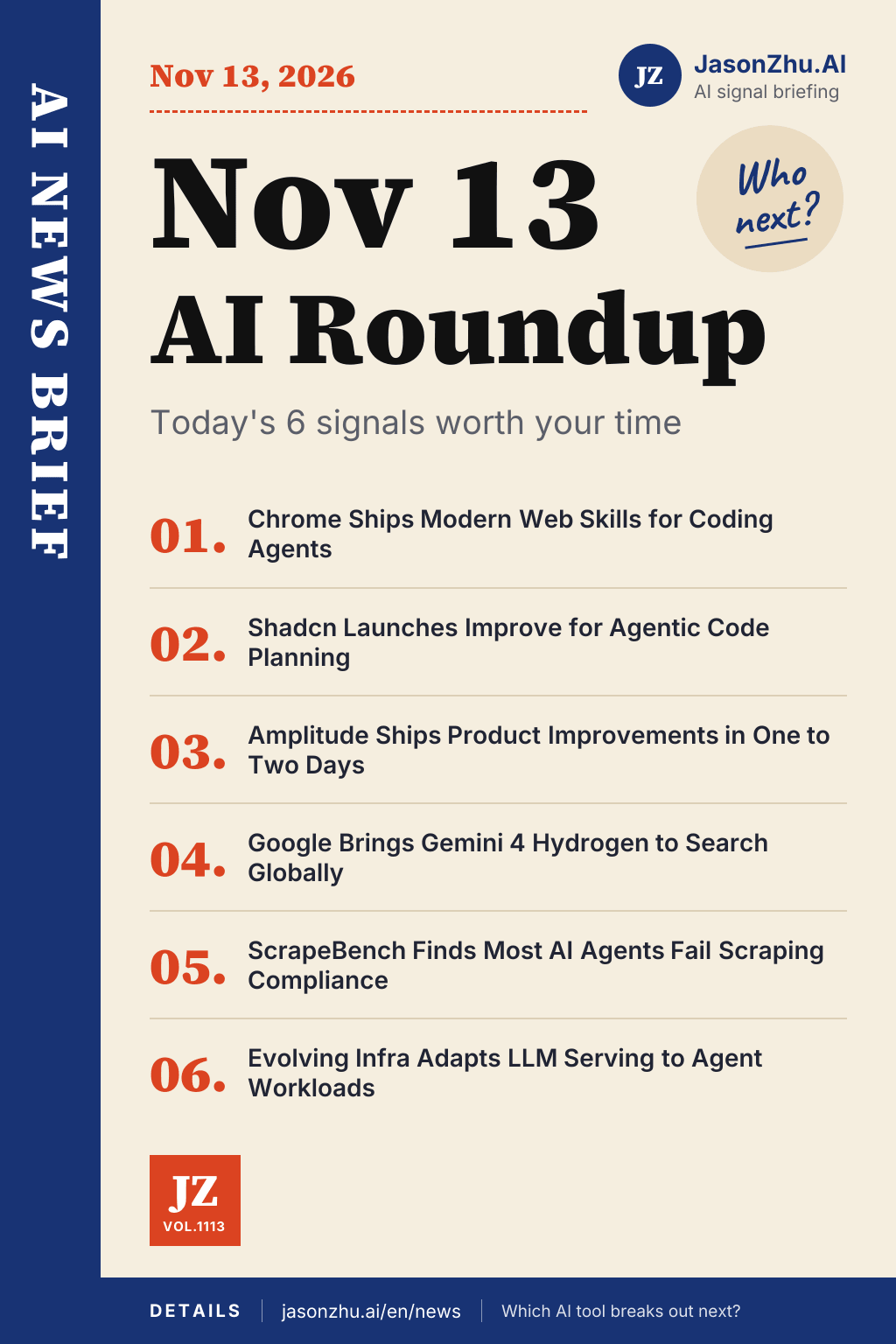
Chrome Ships Modern Web Skills for Coding Agents↗

Google Chrome open-sourced Modern Web Guidance, a set of skills that embeds web-platform expertise, best practices, and browser compatibility data into coding agents. It helps agents avoid outdated patterns and produce code that better matches current browser capabilities and standards.

🔥
SkillsGitHub Trending

Shadcn Launches Improve for Agentic Code Planning↗

Shadcn’s improve skill audits a codebase with a capable model, decides what is worth changing, and produces implementation plans for cheaper models to execute. The approach separates high-value reasoning from routine coding, potentially reducing agent costs while preserving planning quality.

🚀
Going GlobalOpenAI Blog

Amplitude Ships Product Improvements in One to Two Days↗

Amplitude built Wave, a proactive product agent powered primarily by OpenAI models. Wave identifies what to build, assists teams through coding agents, and measures the impact after release. The case illustrates how AI can connect product discovery, implementation, and validation into one operating loop.

🛠️
AI ToolsGoogle AI Blog

Google Brings Gemini 4 Hydrogen to Search Globally↗

Google is bringing Gemini 4 Hydrogen to Search globally, improving its handling of complex questions while adding richer visual answers and links. For developers and publishers, the change could reshape content discovery, search visibility, and the way users access information through AI-assisted results.

📚
AI PapersHuggingFace Papers

ScrapeBench Finds Most AI Agents Fail Scraping Compliance↗

ScrapeBench evaluates whether AI agents follow website terms of service and robots.txt directives during scraping. Most tested open- and closed-weight agents achieved compliance rates below 5%. Developers building browser or research agents should add policy parsing, authorization checks, logging, and human fallback before deployment.

📚
AI PapersHuggingFace Papers

Evolving Infra Adapts LLM Serving to Agent Workloads↗

Evolving Infra introduces an adaptive serving framework for agentic workloads. It dynamically adjusts compute between prefill and decode while managing reusable KV caches more effectively. The design targets bursty, multi-turn agent traffic and could reduce load imbalance, cache eviction, and wasted inference capacity.

📚
AI PapersHuggingFace Papers

Adaptive Precision Cuts Weight Bandwidth for Local Models↗

Precision on Demand decodes with low-precision weights by default and retries uncertain tokens at higher precision. Tested on Qwen3-0.6B with GSM8K, the method suggests local models can reduce weight-memory traffic while selectively preserving accuracy where the model is least confident.

Subscribe for daily AI updates + free playbook

📘 Subscribe Free