AI News · 2026-11-26

· JasonZhu.AI · Compiled by AI

AI News · 2026-11-26

AI summary · this digest is compiled by AI, not yet reviewed by Jason

The focus today is on the infrastructure shift in the developer ecosystem, with new standards for CLI-agents and Cursor plugins bridging the gap between AI and deep system control, while MiniMind demonstrates the potential for lightweight model research on consumer hardware.

🔥
SkillsGitHub Trending

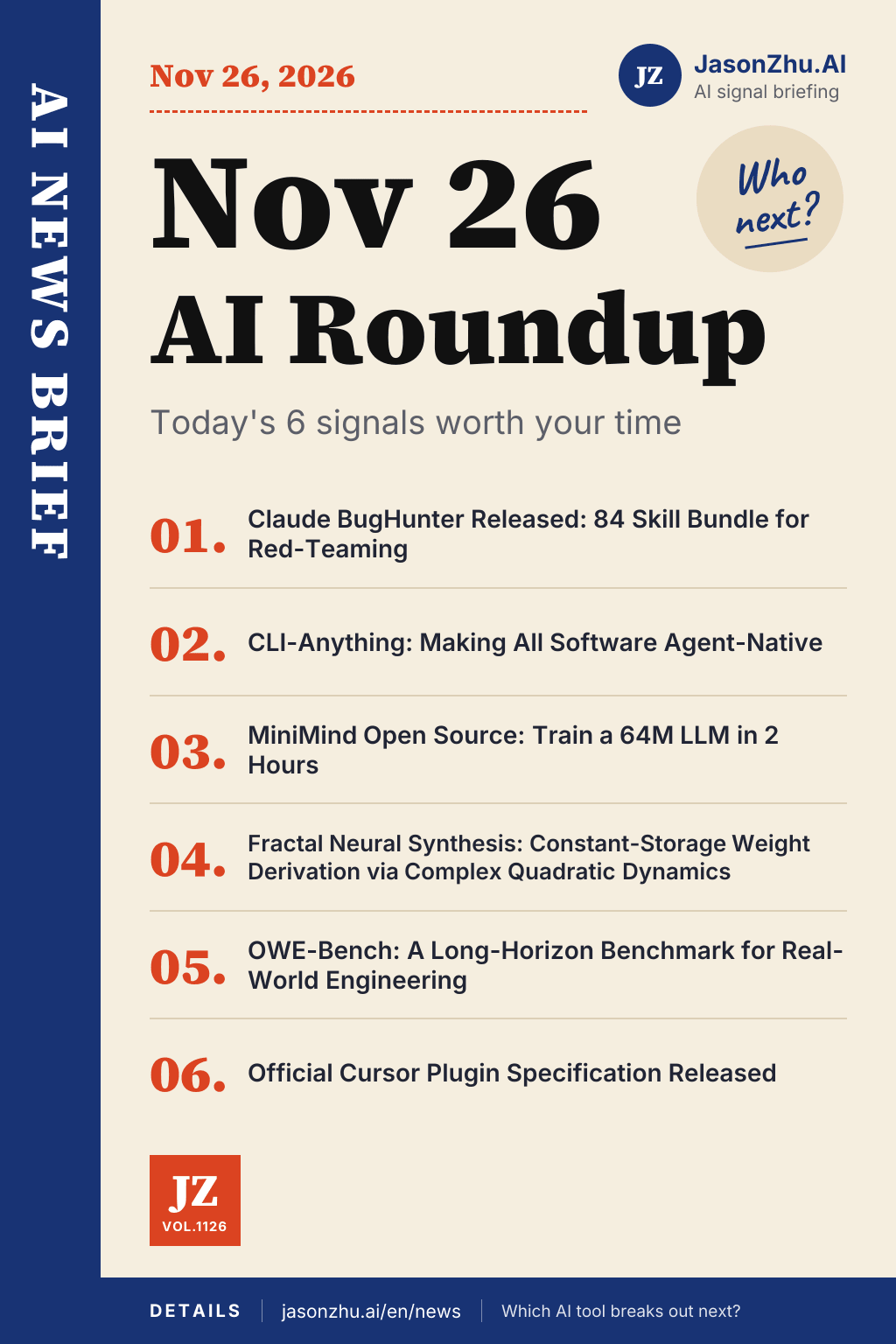
Claude BugHunter Released: 84 Skill Bundle for Red-Teaming↗

This project offers a Claude Code skill bundle for red-teaming, featuring 84 skills, 15 slash commands, and 681 vulnerability report patterns. It significantly lowers the barrier for developers and security researchers to automate vulnerability scanning and infrastructure stress-testing.

🔥
SkillsGitHub Trending

CLI-Anything: Making All Software Agent-Native↗

CLI-Anything introduces a unified CLI-Hub standard to turn traditional software into agent-native tools. It solves the critical pain point of AI agents struggling to interact with local closed-source applications, accelerating the 'software-as-a-tool' ecosystem integration.

📚
AI PapersGitHub Trending

MiniMind Open Source: Train a 64M LLM in 2 Hours↗

This project demonstrates how to train a 64M parameter LLM from scratch on a consumer GPU with minimal cost (3 RMB) and time (2 hours). It covers the entire pipeline including pretraining, SFT, and RLHF, offering high educational value for lightweight model research and deployment.

📚
AI PapersHuggingFace Papers

OWE-Bench: A Long-Horizon Benchmark for Real-World Engineering↗

OWE-Bench introduces a benchmark featuring 26 long-horizon engineering tasks requiring deep reasoning across software, physical, and scientific computing. It provides a more practical metric for evaluating the real-world execution capability of AI agents compared to standard benchmarks.

🛠️
AI ToolsGitHub Trending

Official Cursor Plugin Specification Released↗

Cursor has released its official plugin specification with a unified manifest structure. This marks a transition from a standalone editor to an ecosystem platform, enabling developers to easily extend AI coding assistants with specialized toolchain functionality.

Subscribe for daily AI updates + free playbook

📘 Subscribe Free